Research
Interpreting Latent CoT Reasoning as Dynamical Systems
Mechanistic interpretability paper, ICML 2026 FoGen Workshop poster
- Timeline
- Feb 2026 to May 2026
- Affiliation
- Algoverse AI Research Fellowship
- Team
- Sabari Iyyappan Duraipandian, Manju Nagesh, Jerome Francis, Archana Vaidheeswaran, Kevin Zhu
- Recognition
- Poster, ICML 2026 FoGen Workshop
- GSM8K samples
- 8,792
- Trajectory dimension
- 768
- Samples with an unstable DMD mode, COCONUT vs CODI
- 41% vs 85%
- Verified claims
- 28 of 28
- Reviewer rating
- 6 of 6
What it is
Treats each latent thought token of a chain-of-thought language model as a state in a discrete-time trajectory and applies dynamical-systems analysis to 768-dimensional reasoning trajectories across 8,792 GSM8K and 500 MATH samples.
Problem
Latent reasoning methods such as CODI and COCONUT keep multiple superimposed candidate traces in hidden space at every step, so existing mechanistic tools reveal compression and shortcuts but cannot explain how reasoning evolves from one latent step to the next.
Approach
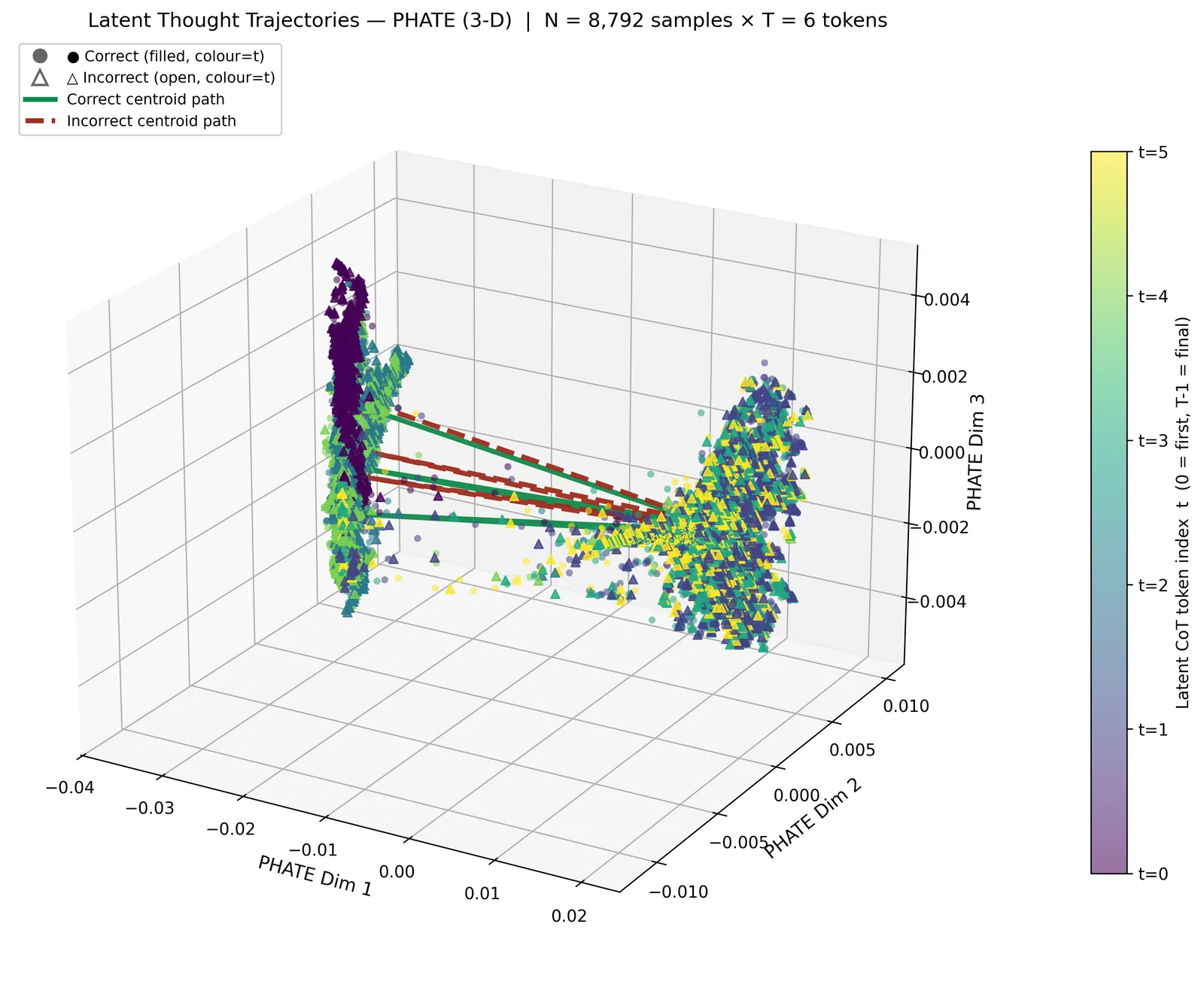
Model the six latent hidden states as a trajectory; measure step-to-step change, direction consistency, arc length, a Lyapunov surrogate and perturbation divergence; project with DMD, PHATE, UMAP, PCA and t-SNE across four model configurations (CODI and COCONUT, vanilla and Sim-CoT) on GPT-2-small.
Highlights
CODI behaves as a stable attractor while COCONUT behaves as an unstable expanding system; Sim-CoT supervision tightens both without changing the dynamics.
Reproduced CODI self-distillation and the COCONUT four-stage latent curriculum end to end as rank-128 LoRA adapters with PyTorch, Transformers and PEFT.
Built the reliability layer: CUDA health-polling orchestration for 14+ hour runs, HDF5 resume-from-cache, a GPU-resident Kraskov KSG-1 mutual-information estimator and a byte-exact safetensors checkpoint repair.
Verification harness passes 28 of 28 reproducible numeric claims; fixed seeds, greedy decoding and pinned dependencies throughout.